Part 1: Reviewing “Transability”
The game “Transability” is an interesting serious game because it doesn’t essentially have a definitive ending. It seems like it’s an interactive story-telling game, similar to role-playing for the sake of education however, this game actually lacks an objective for the gamer to complete and rather after a period of time goes by, the game ends. So, instead of on the gamer’s terms, the game creates the ending. I tried making different choices within the game, however each one lead to the same outcome. This for me doesn’t seem exactly how a game should go, because there should be “consequences” for your decisions (which is nearly the point of a game). Here, the consequences from the choices the player makes are so loose that it does not effect the outcome, it only changes the conversation slightly between the two people in the game. Clearly the point here is to educate but I think this one is far removed from defining as a “game”. Transability should be labeled as something similar to a power point and not labeled as a game since once the education is delivered, it ends.
The game Transability (https://fringfrang.itch.io/transability was created by Dave Shaw and Chad Comeau, in order to spread awareness on BIID (Body Integrity Identity Disorder), also known as transableism. I’ve honestly never heard of it in my life before today so I was in utter shock that this disability exists. As I read more about the topic, it seems so controversial, and even ironic. Is it a disability, or an identity? Did I actually learn something here? Did this game cause me to just be aware that this exists, or was there a goal to get me to accept and appreciate this “disability”? Do people choose this disability, do they choose to be disabled, or do people have a disability that makes them think they’re disabled? The game makes all of this unclear, all it does is initiate the thoughts that spiral in my mind about this. As I read their website from the creator, they interviewed Dr. Clive Baldwin., Canada Research Chair in Narrative Studies at St. Thomas University who has been conducting research on the experience of living with BIID. Therefore, I can conclude that this game intentionally is about simply the experience of living with BIID or knowing someone who has BIID. Plain and simple, there’s no goal other than to experience the experience. Pretty vast right?
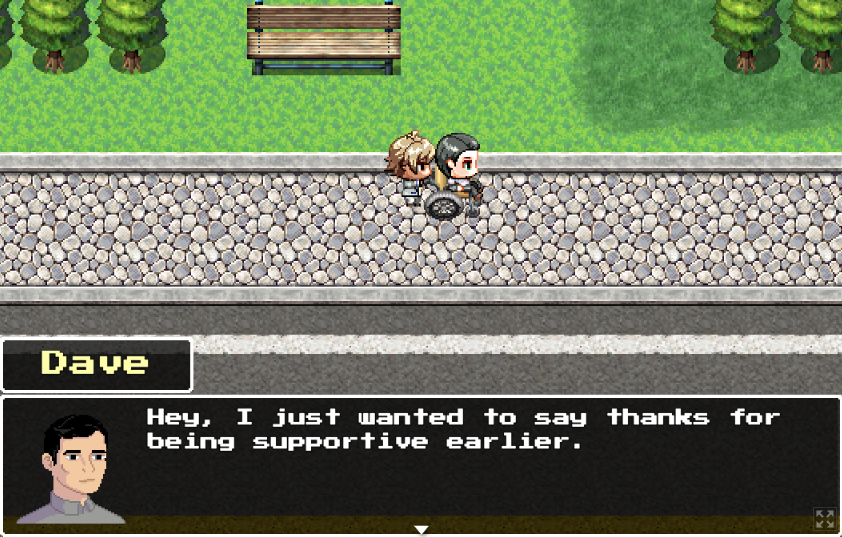
I really don’t think this challenges the “game players” on the “4Cs” which I can reference from Schrier’s work. As I reflect on the characteristics of what a serious game entails, it seems that the selected game does not fulfill these. There are clearly no given rules because you can make whatever decisions possible in the game which give you the same outcome. There’s absolutely no way around it (I’ve tried doing all the wrong things in the game). The game does not require critical thinking because there are no consequences or things at stake. The game takes places as a person (you) who is friends with “Dave” (someone who has BIID), and you begin in his house because you’re visiting him. You realize he’s in a wheelchair when he rolls into screen. The only actions you make in this game is to respond to his commentary. So, as for the 4 “C’s” the only one that was applied here is communication. Although as the conversation goes, it seems like you have power over the outcome, it enables you to think something is at stake so therefore you try your best to respond in the most polite and rational way. However, when I played again and made the decisions to respond irrationally, the outcome was always the same. Was the game an internal one about being polite to people even though you have no idea what they’re going through and no way to relate? If that was the case, wouldn’t there be a consequence for responding on a “phobic” way? I’m stuck on this.
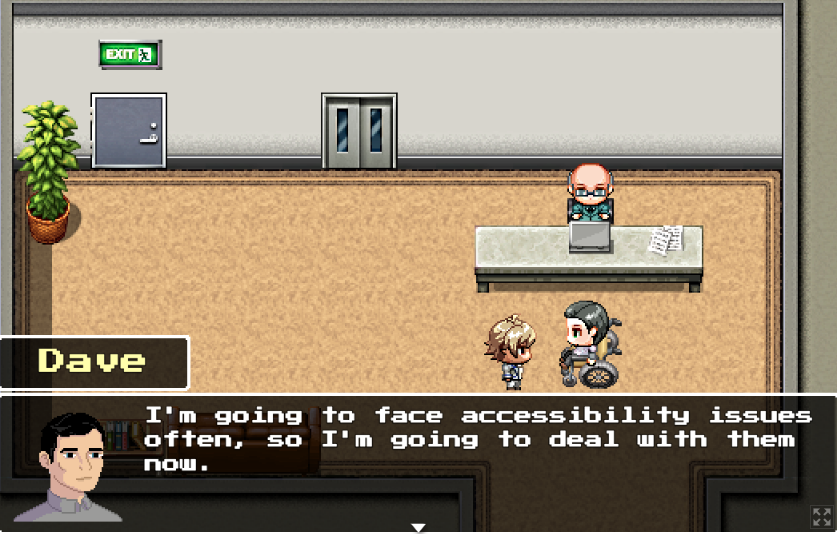
I learned that there is no strategy or learning here other than to receive the information read at the bottom as if I’m reading a video with subtitles. Essentially, I did learn something new, but who’s to say I’m for or against it? There is no underlining agenda within this “game”, or should I say, “powerpoint”.
 Serious Games Blog