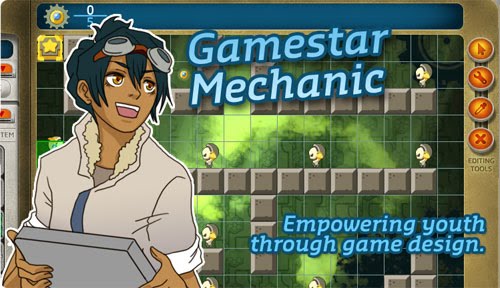
Platform located here: Gamestar Mechanic
I was intrigued when playing the children’s gaming platform and community Gamestar Mechanic, in class, which is known for teaching students, particularly the youth, about game mechanics through a quest-based learning approach.
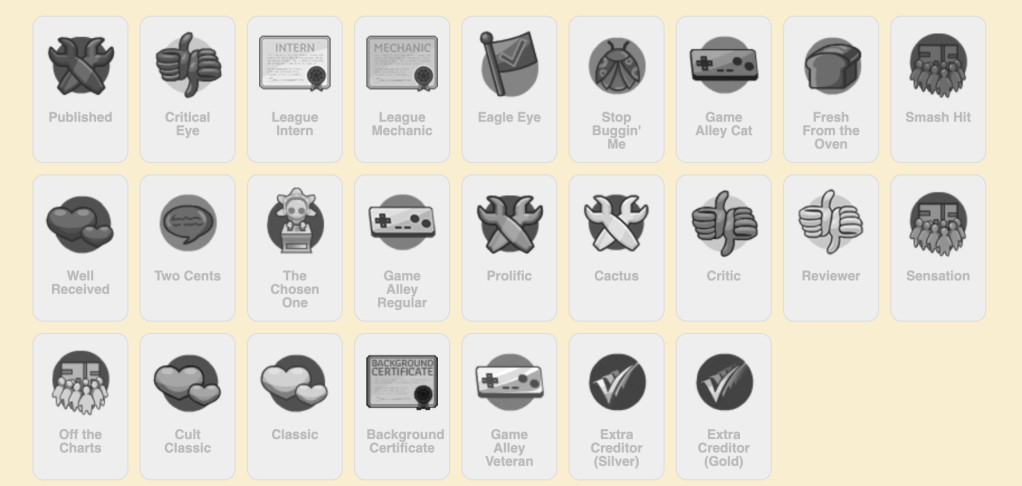
Basically, there are two routes for users when using this platform which provides a large range of emergence. Student’s can play for fun by simply playing games or quests and completing the game within the platform or they can beat the rest of the players in experience rank on Gamestar Mechanic by becoming maxed out in experience (XP), thus top rank which is called: Master Mechanic. In addition to your rank, as you play, create and participate more in the community, you will earn badges for particular accomplishments as you play Gamestar. See these badges below:
The outcomes in most video games are very large and practically infinite. However, within this platform, there’s definitely infinite outcomes within the fact that games are always being created and posted on this platform. In addition though, unlike most video games, there is an end that is reached here regarding rank which is the basic foundation of this platform which is when you reach Master Mechanic.
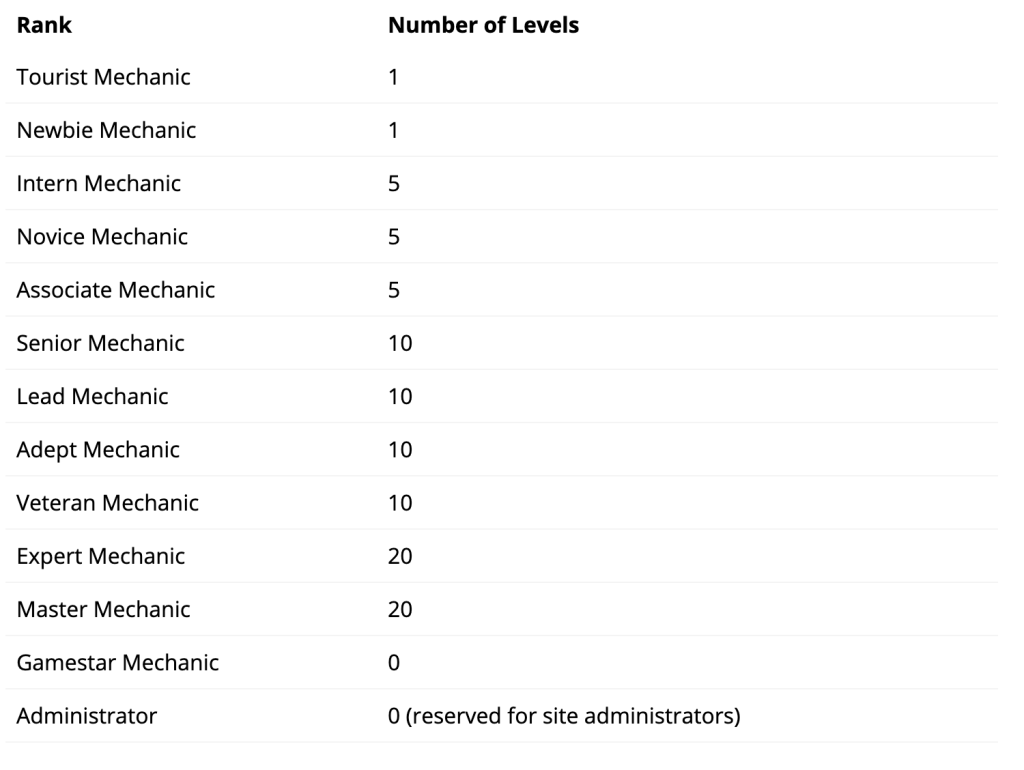
Below are the ranks for Gamestar Mechanic.
To begin, student’s first create a profile, and within this profile students have the option to earn “sprites” as a result of moving through the quests developed by the creators of Gamestar Mechanic. This platform also gives any user the opportunity to build their own game as well. Designing and publishing a game earns users “badges” creating a higher rank which could be a game within itself as well. This “Mechanic Rank” reflects how experienced a player is are as a game designer. As noted on the Gamestar Mechanic’s website: “…it’s not all about publishing your own games — that’s just one part. The most respected designers play games to learn from others.” Hence, there’s more to it than just simply designing a game to increase your rank, which is the goal in this aspect of the platform. Gamestar Mechanic has four kinds of Experience points (XP), and you will have to earn them all equally to level up. It requires a certain experience from each that adds up slowly in four different facets to rank up to next level under designer XP, player XP, review XP, and citizen XP.
For review experience (rXP), you must review and leave a rating on a game in Game Alley whilst signed into your account. Regarding emergent gameplay, this also consist of glitches. For this specific platform, they incorporated to resolve or prevent glitches by making it mandatory to the goal of the game to help write reviews for games. Specifically, leaving comments about what needs work or what worked well is great content that is helpful towards making Gamestar Mechanic platform a great space to grow it’s technology. It gives you more XP when you leave actual reviews rather than leaving stars-and-gears. To note, it’s important to have this kind of knowledge on reviewing a game, because you need to be fully knowledgable when making your OWN games.
Second, you gain experience (dXP) by designing a game by creating and publishing publicly the games you’ve made so that players that use this platform can play them. The place you can locate these games are in Game Alley and the more the game is played, the more you gain dXP. Also, there’s another way to receive designer experience which is by the quest missions under “Build and Repair”. I can educationally guess that this could be because it’s likely that it’s difficult to gain this XP if not many players want to play the game you’ve created.
As player experience (pXP) is self explanatory, you have to note that either playing games from Game Alley or games in the Quest, they only count towards pXP the first time you play. After that, it doesn’t cunt towards your experience.
Lastly, but not least, citizen experience (cXP) is a team effort but also is measured by how much of a team player you really are by earning experience by playing games that haven’t been played as much. This really coincides and helps out with the goal that you need to gain experience from making a game and having people play it. So, even if you design a game poorly and it’s not pulling up in the search as something top chart worthy, you will still have people playing due to the fact that it’s a requirement for them too. It’s as if you will inevitably grow because people will help you gain that experience (by playing your game, and leaving intricate and helpful reviews) and vice versa.
In addition to these rules of gaining experience towards the goal of the game’s platform, there can always be issues that arise. So, Gamestar Mechanic built in an option that you can flag or comment about a bug in a game’s coding or flag something inappropriate in the comment/review section. When you help out in this way, you can potentially earn XP too.
Overall, this platform is very intricate involving its emergence. In a broad sense, each experience plays as the game’s rules and comes in full circle. They all need one another for their to be structure to this platform. In the common usage its unique happenings based on game rules. The experience of this platform is definitely an intriguing one. Rather than just a simple and straight forward game, the platform itself acts as a game. This creates a more complex gaming experience and also brings forth more rules and end-game goals to achieve.
Nowadays with social media platforms and intricate gaming consoles (such as Xbox and Playstation and Nintendo), these mediums have influenced and shaped the way that people experience gaming and internet activities. The pattern of creating a platform where you can great a profile and manage multiple different things and achieve different things within the platform is exactly the time of 21st century skills the game Gamestar Mechanic embodies.
 Serious Games Blog