A game is a fun thing with an objective and asks you and multiple people to participate.
A serious game is one that has a clear objective and set rules, but is not necessarily geared towards having fun. The objective is to have gained some sort knowledge or skills in a particular field Corti states that game-based learning/ serious games “is all about leveraging the power of computer games to captive and engage end-users for a specific purpose, such as to develop new knowledge and skills”(Corti, 2006). I believe serious games are for improving cognitive functions especially those associated with learning, while a regular game has the objective of entertaining.
Part 2: Applying My Definition of A Serious Game to a Serious Game
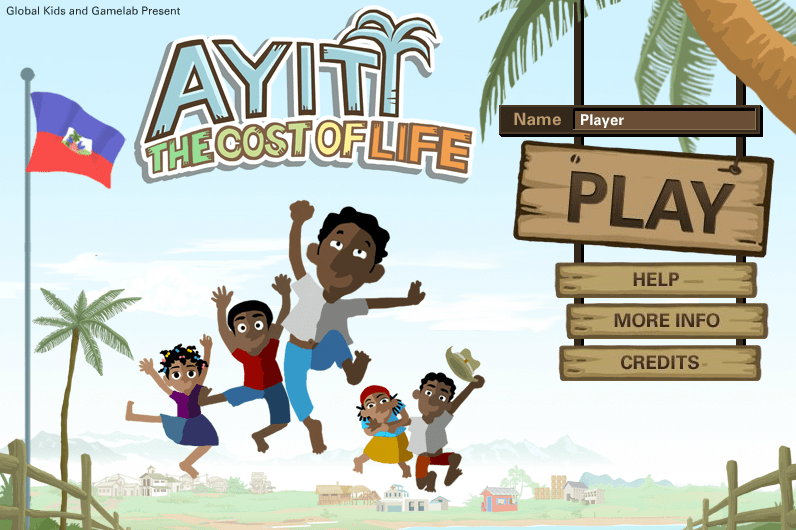
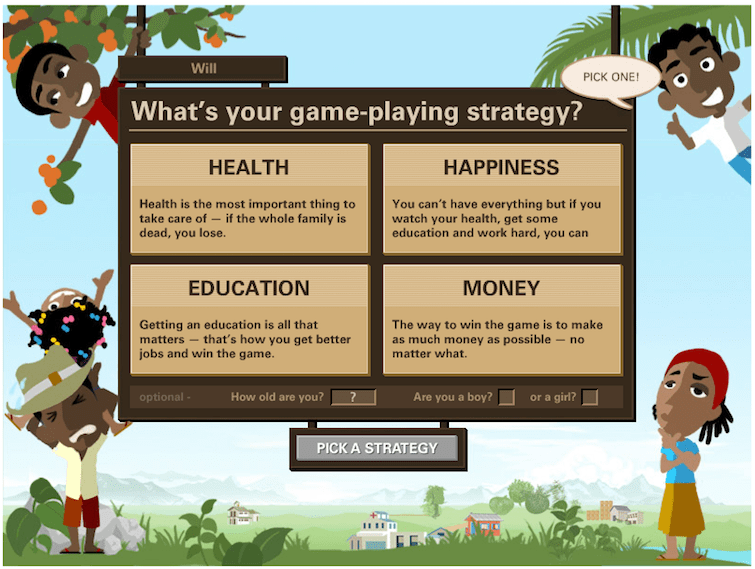
The game i played was Ayiti: The Cost of Life and it did match the criteria for a serious game. The game too a lot of effort (keeping characters alive, educated, etc), all while under major constraints (potential to die, bad weather, sickness, lack of food/money). But throughout the game there was a clear objective which was to obtain enough education to be able to sustain the family. The game itself was very informative because it dealt with the risks that the people of Haiti face on a daily basis.
My overall experience was that I was challenged. It took me a few trial and error rounds (or seasons), to gage how the game would react and treat each decision I made. This game is definitely advanced and takes a while to get familiar with the challenges. I tried to start over from scratch because I was having a hard time dealing with income and profit. First time around by the second year, the family in totally was in debt, sick, and starved to death.
I learned that the strategy is all about making more than you spend within a season whilst making sure everyone’s overall health doesn’t kill them. The game is set out in extreme harsh conditions and every move you make is vital. It’s not like the typical tycoon video games, this takes conscious strategy and preparation before making each move (since each move really does matter.)
I was intrigued when playing the children’s gaming platform and community Gamestar Mechanic, in class, which is known for teaching students, particularly the youth, about game mechanics through a quest-based learning approach. Basically, this is the
I was intrigued when playing the children’s gaming platform and community Gamestar Mechanic, in class, which is known for teaching students, particularly the youth, about game mechanics through a quest-based learning approach.
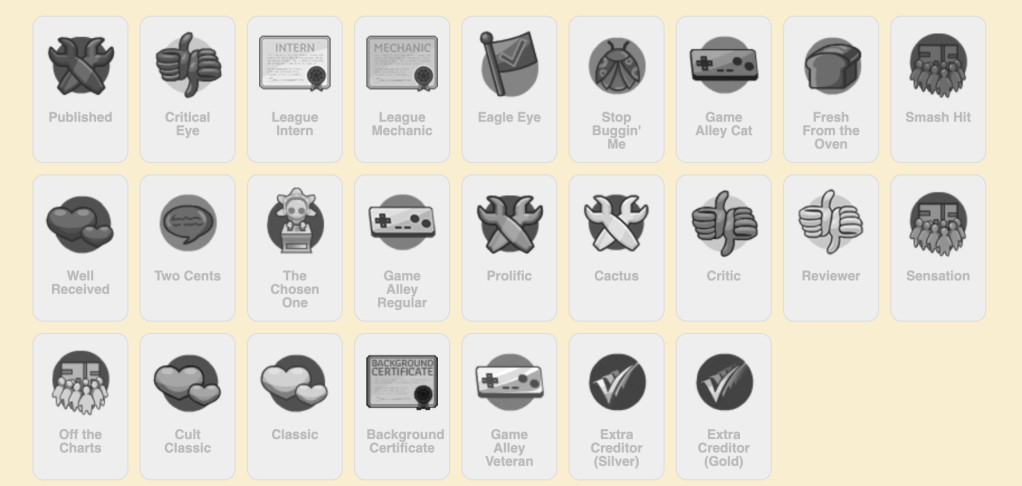
Basically, there are two routes for users when using this platform which provides a large range of emergence. Student’s can play for fun by simply playing games or quests and completing the game within the platform or they can beat the rest of the players in experience rank on Gamestar Mechanic by becoming maxed out in experience (XP), thus top rank which is called: Master Mechanic. In addition to your rank, as you play, create and participate more in the community, you will earn badges for particular accomplishments as you play Gamestar. See these badges below:
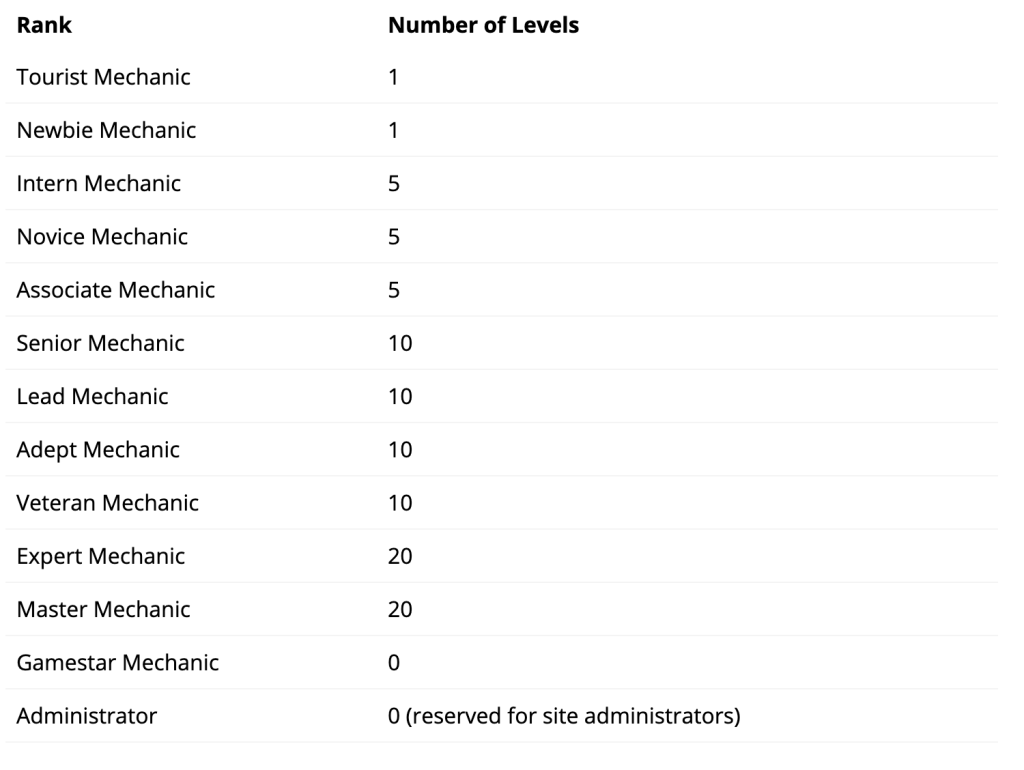
The outcomes in most video games are very large and practically infinite. However, within this platform, there’s definitely infinite outcomes within the fact that games are always being created and posted on this platform. In addition though, unlike most video games, there is an end that is reached here regarding rank which is the basic foundation of this platform which is when you reach Master Mechanic.
Below are the ranks for Gamestar Mechanic.
To begin, student’s first create a profile, and within this profile students have the option to earn “sprites” as a result of moving through the quests developed by the creators of Gamestar Mechanic. This platform also gives any user the opportunity to build their own game as well. Designing and publishing a game earns users “badges” creating a higher rank which could be a game within itself as well. This “Mechanic Rank” reflects how experienced a player is are as a game designer. As noted on the Gamestar Mechanic’s website: “…it’s not all about publishing your own games — that’s just one part. The most respected designers play games to learn from others.” Hence, there’s more to it than just simply designing a game to increase your rank, which is the goal in this aspect of the platform. Gamestar Mechanic has four kinds of Experience points (XP), and you will have to earn them all equally to level up. It requires a certain experience from each that adds up slowly in four different facets to rank up to next level under designer XP, player XP, review XP, and citizen XP.
For review experience (rXP), you must review and leave a rating on a game in Game Alley whilst signed into your account. Regarding emergent gameplay, this also consist of glitches. For this specific platform, they incorporated to resolve or prevent glitches by making it mandatory to the goal of the game to help write reviews for games. Specifically, leaving comments about what needs work or what worked well is great content that is helpful towards making Gamestar Mechanic platform a great space to grow it’s technology. It gives you more XP when you leave actual reviews rather than leaving stars-and-gears. To note, it’s important to have this kind of knowledge on reviewing a game, because you need to be fully knowledgable when making your OWN games.
Second, you gain experience (dXP) by designing a game by creating and publishing publicly the games you’ve made so that players that use this platform can play them. The place you can locate these games are in Game Alley and the more the game is played, the more you gain dXP. Also, there’s another way to receive designer experience which is by the quest missions under “Build and Repair”. I can educationally guess that this could be because it’s likely that it’s difficult to gain this XP if not many players want to play the game you’ve created.
As player experience (pXP) is self explanatory, you have to note that either playing games from Game Alley or games in the Quest, they only count towards pXP the first time you play. After that, it doesn’t cunt towards your experience.
Lastly, but not least, citizen experience (cXP) is a team effort but also is measured by how much of a team player you really are by earning experience by playing games that haven’t been played as much. This really coincides and helps out with the goal that you need to gain experience from making a game and having people play it. So, even if you design a game poorly and it’s not pulling up in the search as something top chart worthy, you will still have people playing due to the fact that it’s a requirement for them too. It’s as if you will inevitably grow because people will help you gain that experience (by playing your game, and leaving intricate and helpful reviews) and vice versa.
In addition to these rules of gaining experience towards the goal of the game’s platform, there can always be issues that arise. So, Gamestar Mechanic built in an option that you can flag or comment about a bug in a game’s coding or flag something inappropriate in the comment/review section. When you help out in this way, you can potentially earn XP too.
Overall, this platform is very intricate involving its emergence. In a broad sense, each experience plays as the game’s rules and comes in full circle. They all need one another for their to be structure to this platform. In the common usage its unique happenings based on game rules. The experience of this platform is definitely an intriguing one. Rather than just a simple and straight forward game, the platform itself acts as a game. This creates a more complex gaming experience and also brings forth more rules and end-game goals to achieve.
Nowadays with social media platforms and intricate gaming consoles (such as Xbox and Playstation and Nintendo), these mediums have influenced and shaped the way that people experience gaming and internet activities. The pattern of creating a platform where you can great a profile and manage multiple different things and achieve different things within the platform is exactly the time of 21st century skills the game Gamestar Mechanic embodies.
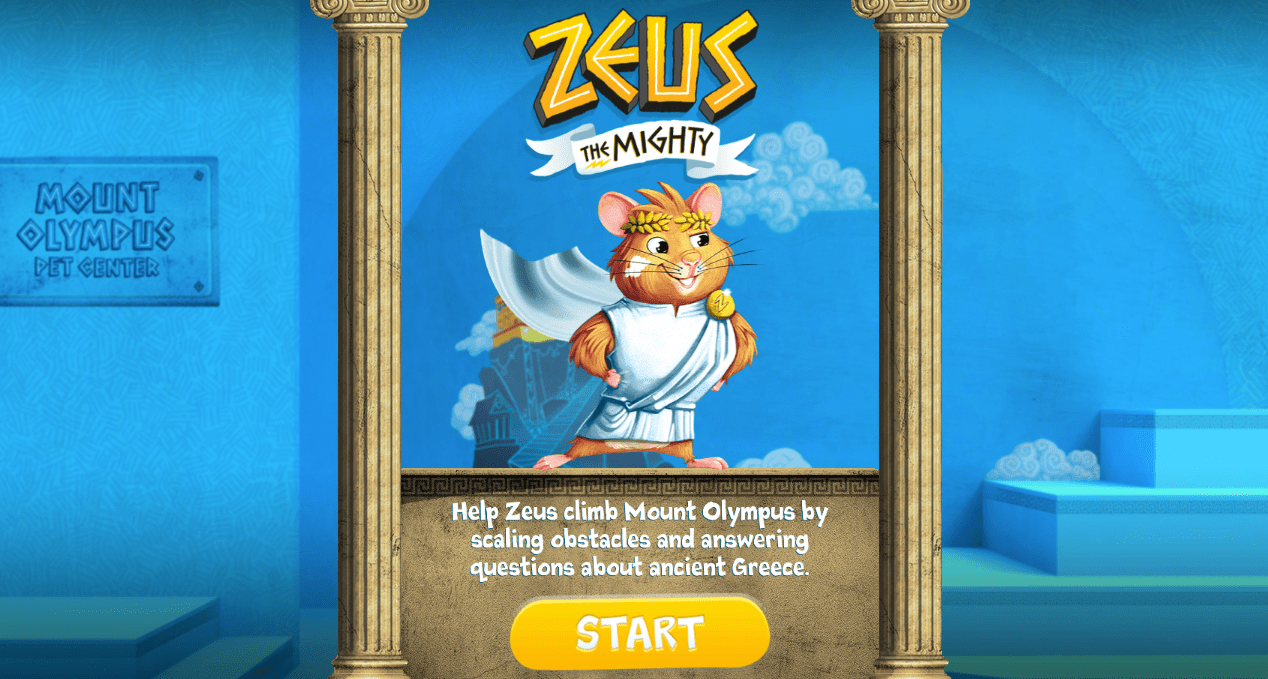
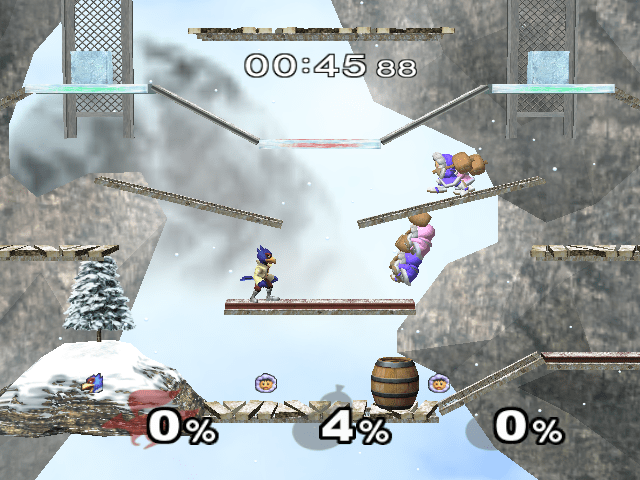
I was intrigued to pick the game, Zeus the Mighty Game because I have a love for Greek and Roman history (including Mythology). So, the simple title and subject of the game influenced my decision-making to play the game rather than the other games I played like “The Nerd Personality Quiz” and Bug Bash. The core goal of the Zeus the Mighty game is similar to many popular games such as the Super Smash Bro’s icicle mountain map, on Nintendo Game Cube console (visual shown below). Essentially, the goal is to always stay ahead of the camera’s speed and each “round” gets more difficult with advancing velocity/speed, moving objects, more obstacles, etc.
Super Smash Bro’s (Nintendo Game Cube)
In Zeus the Mighty game, once playing, I didn’t exactly enjoy the “reward” the way I thought I would due to the misleading message that there would be “knowledge” required to play. I thought I’d be more challenged than I was. That’s not to say it’s not addicting to see how far you’d go with it. This game simply feels like it’ll never end. Your only motivation is to compete with your previous score. The subconscious goal is to get the “best score” you possibly can because you’re competing with yourself. “Game over” happens you run out of lives or when you simply get too tired! It reminds me of the Helicopter game on AddictingGames.com which I used to play all the time as a kid growing up. Instead of a horizontal challenge, the Helicopter game is a horizontal challenge to dodge the obstacles presented quickly in frame.
Helicopter Game (Addicting Games)
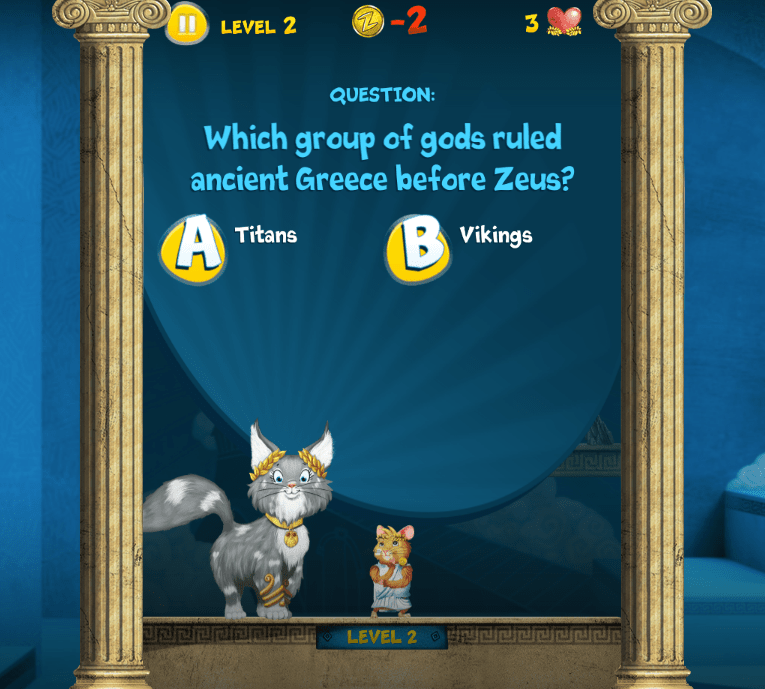
Here there’s some minor differences, the first 5 rounds are pretty easy as far as speed goes which is why I didn’t feel so challenged. Even the illustrations seem to be geared towards a younger crowd. Although the illustrations seem to draw more youthful people (aka children), I find it uplifting and quirky to play a game that’s lighthearted, and designed with vibrant color palette and paintbrush-like textures to the background illustrations. The columns on the right and left match the subject of the game as well. Blue and brownish-yellow are great colors to incorporate together since they are complimentary colors on the color wheel. Due to this, it’s a very cohesive, well-put together game. Everything about the “aesthetic” and elements follows the core functionality and subject on Mythology portrayed.
When playing, after each round is complete, there is in fact a questionnaire to challenge the player on Mythological “facts” (I say that loosely in quotations because of how Mythology stories and information changed throughout time). This questionnaire is pretty easy as well. The questions are straight forward, multiple choice (only between two choices, making it a 50/50 chance), not requiring too much critical thinking but rather tapping into memorized information. Could we say that’s “critical thinking”? You’re not really applying that information to something but rather regurgitating your knowledge back out.
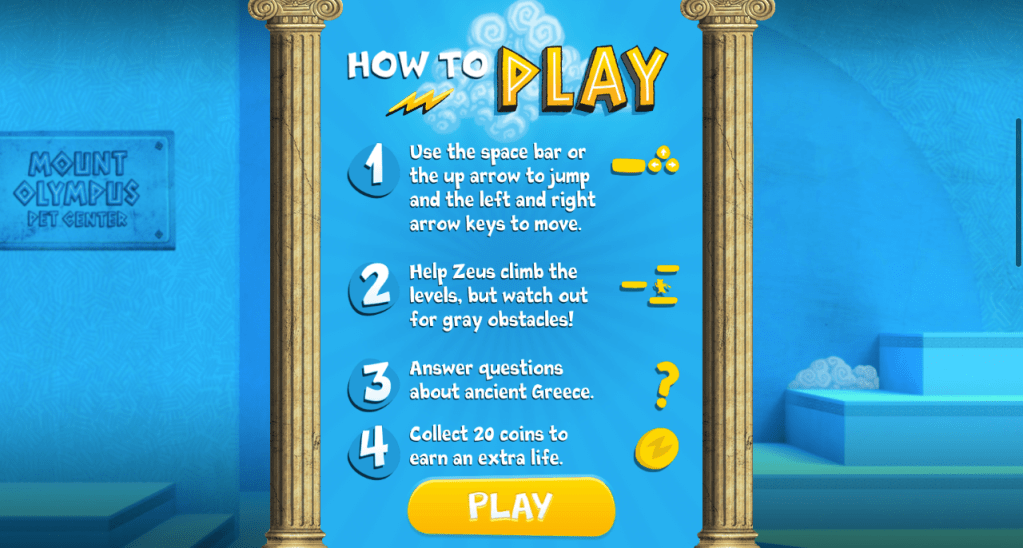
At first, I wanted to get them right. But, like I always do, I challenge the system. I wanted to see what would happen if you get the information wrong (because clearly I knew the answers!). So, you lose a life if you get the information wrong. You start the game with 3 lives and can gain more if you collect 20 coins (there’s about that many in each level) or if you answer the questions correctly at the end of each level you are rewarded with 6 coins. The crazy thing is, you don’t lose a life if you are in the negative or at 0 with your coins. However, you lose coins if you hit an obstacle. At least I know I have full control of the outcome within this game, nothing is chance. If I mess up with timing of the keyboard/buttons, then it’s on me that I fail or succeed.
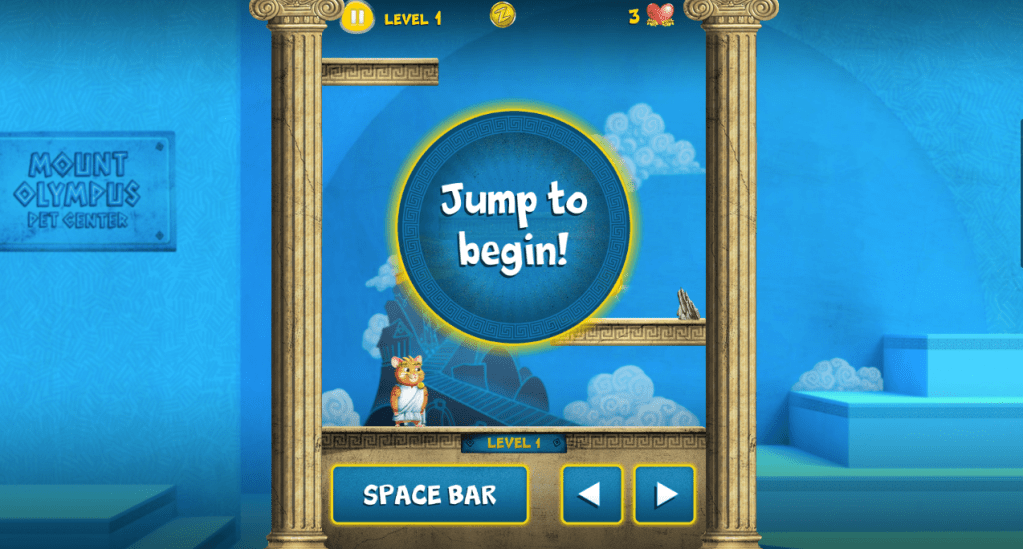
I screenshotted the rules below as well because they were pretty clear since they were stated right before playing:
Overall, it definitely was fun to do rather than the other ones. Felt more upbeat and could get a lot out of it: competition, education (if you don’t know Greek Mythology), and high-blood pressure (because you want to get a better score each time you refresh and start over!). As you review the rules, you definitely can see the game’s core dynamic is a combination of “collection” of coins and “race to the finish” (even though it seems never ending).
As a learning game designer, I got to reflect on the elements used within this game that either I want to implement in mine or to avoid at all costs. It’s safe to say I learned more about what to implement rather than avoid. So, I think how everything came together and was well-thought out is important. The subject of the game has so much weight on how the game will turn out as far as experience, form and functionality. Here, everything flowed together and fitted pretty well. I for one would make it harder if you’re dealing with a different age group, but as for National Geographic kids, this game works so well. The pace was thought out too because it goes very slow within each round, giving time for the player to catch up if they fall or slip up. This shows the intentional design behind the game which I want to make sure I implement in the minor details and as a whole when it comes to designing my own.
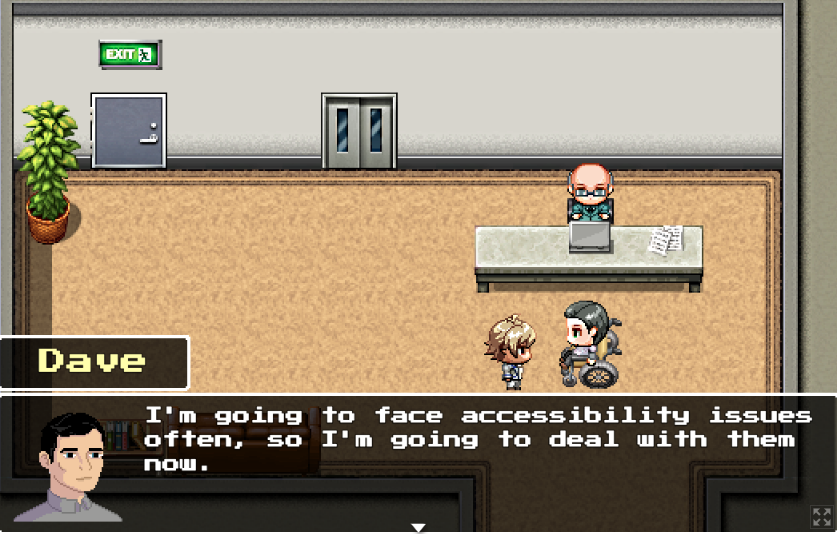
The game “Transability” is an interesting serious game because it doesn’t essentially have a definitive ending. It seems like it’s an interactive story-telling game, similar to role-playing for the sake of education however, this game actually lacks an objective for the gamer to complete and rather after a period of time goes by, the game ends. So, instead of on the gamer’s terms, the game creates the ending. I tried making different choices within the game, however each one lead to the same outcome. This for me doesn’t seem exactly how a game should go, because there should be “consequences” for your decisions (which is nearly the point of a game). Here, the consequences from the choices the player makes are so loose that it does not effect the outcome, it only changes the conversation slightly between the two people in the game. Clearly the point here is to educate but I think this one is far removed from defining as a “game”. Transability should be labeled as something similar to a power point and not labeled as a game since once the education is delivered, it ends.
The game Transability (https://fringfrang.itch.io/transability was created by Dave Shaw and Chad Comeau, in order to spread awareness on BIID (Body Integrity Identity Disorder), also known as transableism. I’ve honestly never heard of it in my life before today so I was in utter shock that this disability exists. As I read more about the topic, it seems so controversial, and even ironic. Is it a disability, or an identity? Did I actually learn something here? Did this game cause me to just be aware that this exists, or was there a goal to get me to accept and appreciate this “disability”? Do people choose this disability, do they choose to be disabled, or do people have a disability that makes them think they’re disabled? The game makes all of this unclear, all it does is initiate the thoughts that spiral in my mind about this. As I read their website from the creator, they interviewed Dr. Clive Baldwin., Canada Research Chair in Narrative Studies at St. Thomas University who has been conducting research on the experience of living with BIID. Therefore, I can conclude that this game intentionally is about simply the experience of living with BIID or knowing someone who has BIID. Plain and simple, there’s no goal other than to experience the experience. Pretty vast right?
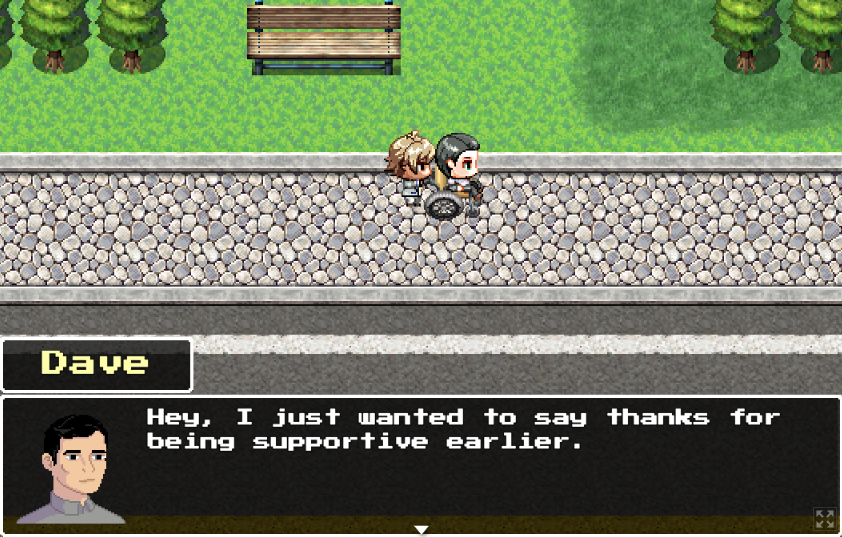
I really don’t think this challenges the “game players” on the “4Cs” which I can reference from Schrier’s work. As I reflect on the characteristics of what a serious game entails, it seems that the selected game does not fulfill these. There are clearly no given rules because you can make whatever decisions possible in the game which give you the same outcome. There’s absolutely no way around it (I’ve tried doing all the wrong things in the game). The game does not require critical thinking because there are no consequences or things at stake. The game takes places as a person (you) who is friends with “Dave” (someone who has BIID), and you begin in his house because you’re visiting him. You realize he’s in a wheelchair when he rolls into screen. The only actions you make in this game is to respond to his commentary. So, as for the 4 “C’s” the only one that was applied here is communication. Although as the conversation goes, it seems like you have power over the outcome, it enables you to think something is at stake so therefore you try your best to respond in the most polite and rational way. However, when I played again and made the decisions to respond irrationally, the outcome was always the same. Was the game an internal one about being polite to people even though you have no idea what they’re going through and no way to relate? If that was the case, wouldn’t there be a consequence for responding on a “phobic” way? I’m stuck on this.
I learned that there is no strategy or learning here other than to receive the information read at the bottom as if I’m reading a video with subtitles. Essentially, I did learn something new, but who’s to say I’m for or against it? There is no underlining agenda within this “game”, or should I say, “powerpoint”.


 Serious Games Blog